May 5, 2026
Why You Can’t Stay Motivated (And What Actually Helps)
If you’ve ever caught yourself saying “I’m just not motivated”, you’re not alone.
At some point most people have struggled to stay consistent with habits they genuinely want. Whether that is movement, rest, healthier routines, creative practices—even when they care deeply about change! And the usual explanations floated on social media not only isn’t really helpful, it can be frustraiting. We’re told to try harder, be more disciplined, or finally “commit.”
But in our experience, motivation isn’t the real issue.
In this conversation, we unpack why change feels so hard, how culture and conditioning work against us, and what actually helps when motivation keeps stalling. Not quick fixes. Not a 180-degree life overhaul. Just honest, sustainable ways forward.
This blog is a companion to the podcast and YouTube episode above.
In this post:
- Why motivation breaks down in the first place
- How culture and productivity pressure shape our habits
- Why seasonal and personal rhythms matter
- What “I’m not motivated” is often really saying
- How changing the container makes habits easier
- The role of guilt, perfectionism, and self-judgment
- Why “truth” takes more work than we expect
- A simple metaphor for approaching change with more grace
- How teachers and wellness spaces unintentionally create friction
Why motivation fails (even when you care)
One of the first questions we ask is a simple one:
Who decided this is how change is supposed to work?
We live inside systems that tie worth to productivity. Doing more, doing it faster, and doing it visibly are rewarded—whether that’s at work, in wellness culture, or even in how we talk to ourselves.
When you’re raised inside those systems, it’s easy to internalize the idea that:
- lack of motivation means laziness
- rest means falling behind
- change should feel decisive and dramatic
So when motivation doesn’t show up, the assumption becomes: something must be wrong with me.
But very often, what’s happening has nothing to do with willpower.

Why timing and energy actually matter
Many people notice that certain times of year (or certain phases of life) feel tougher, or less action-oriented. Energy naturally ebbs and flows. Light changes. Schedules shift. Capacity changes.
And yet, culturally, we expect consistency all the time.
If you’re trying to force high-energy change during a period when your system is more inward, reflective, or tired, it can feel like pushing against something invisible.
That resistance often gets labeled as “lack of motivation,” when it may simply be misalignment.
Some people genuinely feel energized during certain seasons. Others don’t. Neither is a failure, but pretending those differences don’t exist creates unnecessary friction.
Wellness culture, pressure, and the illusion of urgency
It’s not just internal. The external pressure is loud.
Wellness culture thrives on urgency:
- Start now.
- Fix this before it’s too late.
- If you don’t change, you’re doing it wrong.
Add social media to the mix and suddenly every scroll reinforces the idea that change must happen immediately, and visibly, or you’re missing your chance.
That pressure creates fear-based decisions, not sustainable ones. Goals chosen under urgency are often disconnected from what we actually need or can maintain.
“I’m not motivated” usually isn’t the whole truth
When someone says they’re not motivated, we don’t hear a dead end. We hear an invitation to look deeper.
Underneath “I’m not motivated” is often something like:
- I don’t actually want this goal.
- I want it, but the way I think I have to do it feels overwhelming.
- I’m exhausted and don’t feel supported.
- I feel guilty prioritizing myself.
Sometimes the most honest answer is simply: I don’t want to do this, at least not this way.
And that’s not a personal flaw. That’s information.
When we don’t acknowledge that truth, the mind works overtime justifying, explaining, avoiding, and negotiating, which is exhausting. No wonder motivation disappears.
Change the container, not the intention
One of the most helpful shifts we return to again and again is this:
Maybe the goal isn’t wrong. Maybe the container is.
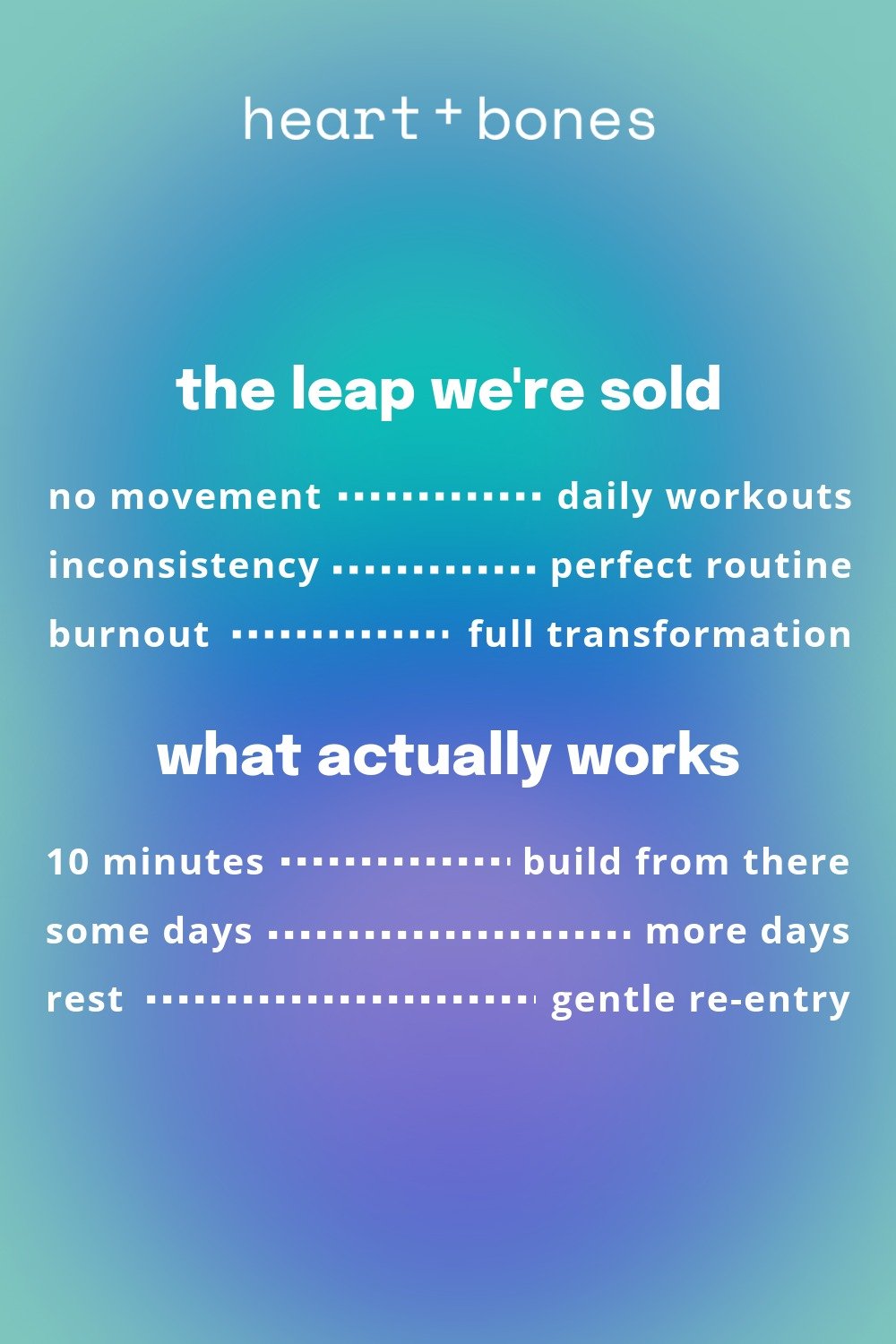
Most people assume change requires a complete overhaul:
- from no movement → daily workouts
- from inconsistency → perfect routine
- from burnout → disciplined transformation
That leap alone can kill momentum.
But when you change how something is structured—shorter sessions, fewer days, more flexibility, more enjoyment—the same intention becomes far more doable.
Small shifts aren’t watered-down change. They’re how change actually happens.
Guilt, conditioning, and why rest feels “earned”
For many people, especially those socialized to care for others, guilt is one of the biggest barriers to consistency.
The internal dialogue sounds like:
- Should I take time for myself… or do something more “productive”?
- Should I move my body… or take care of everything else first?
Often it’s not a lack of time, but rather it’s a lifetime of programming that puts personal needs last by default. Learning to notice that pattern, and gently interrupt it, is part of the practice.
Your “guilty pleasures” aren’t the problem
We also talked about how revealing it is that we call certain things “guilty pleasures.”
Why guilty?
Who decided enjoyment needs justification?
Pairing a habit with something pleasurable isn't cheating. It's understanding how humans work. For example watching a show while walking, listening to an audiobook on a long walk, making movement feel cozy instead of performative
The habit you stick with is almost always the one you enjoy.