Aug. 6, 2026
How to Choose a Yoga Teacher Training: What Actually Matters
How to Choose a Yoga Teacher Training: What Actually Matters (and What Doesn’t)
Choosing a yoga teacher training can be overwhelming.
Search for the best yoga teacher training and you’ll find thousands of options: online programs, destination retreats, local studio trainings, self-paced courses, traditional lineages, modern movement programs, and certifications built around nearly every style of yoga imaginable.
Each one promises something different.
So how do you choose a yoga teacher training that will actually prepare you to teach?
Look beyond the number of poses, the popularity of the lead teacher, or the promise of a fast certification. A strong foundational yoga teacher training should teach you how to understand movement, sequence intentionally, communicate clearly, adapt for different bodies, and make thoughtful decisions when the class in front of you does not match the one you planned.
That foundation matters much more than finding one perfect style.
This blog is a companion piece to a conversation Brea Johnson, Founder and Lead Teacher at Heart and Bones Yoga had on the topic.
explore heart and bones teacher training
An 8-month online certification with Heart and Bones Yoga that blends anatomy-informed movement, inclusive teaching, and the essence of yoga.
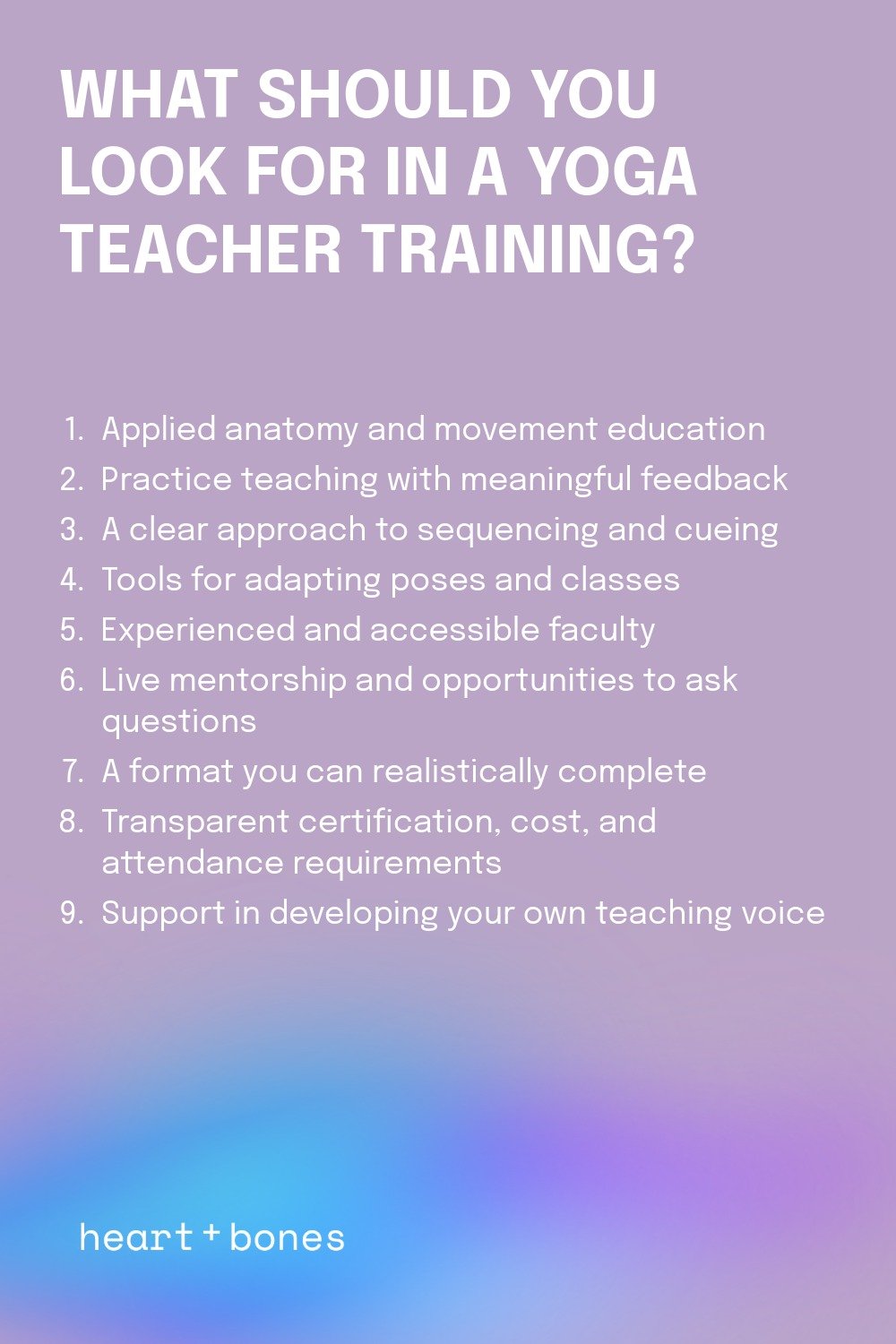
What should you look for in a yoga teacher training?
When comparing yoga teacher training programs, look for:
- Applied anatomy and movement education
- Practice teaching with meaningful feedback
- A clear approach to sequencing and cueing
- Tools for adapting poses and classes
- Experienced and accessible faculty
- Live mentorship and opportunities to ask questions
- A format you can realistically complete
- Transparent certification, cost, and attendance requirements
- Support in developing your own teaching voice
The best yoga teacher training is not simply the one with the biggest name or the most extensive pose library. It is the one that helps you build skills you can use with real people.
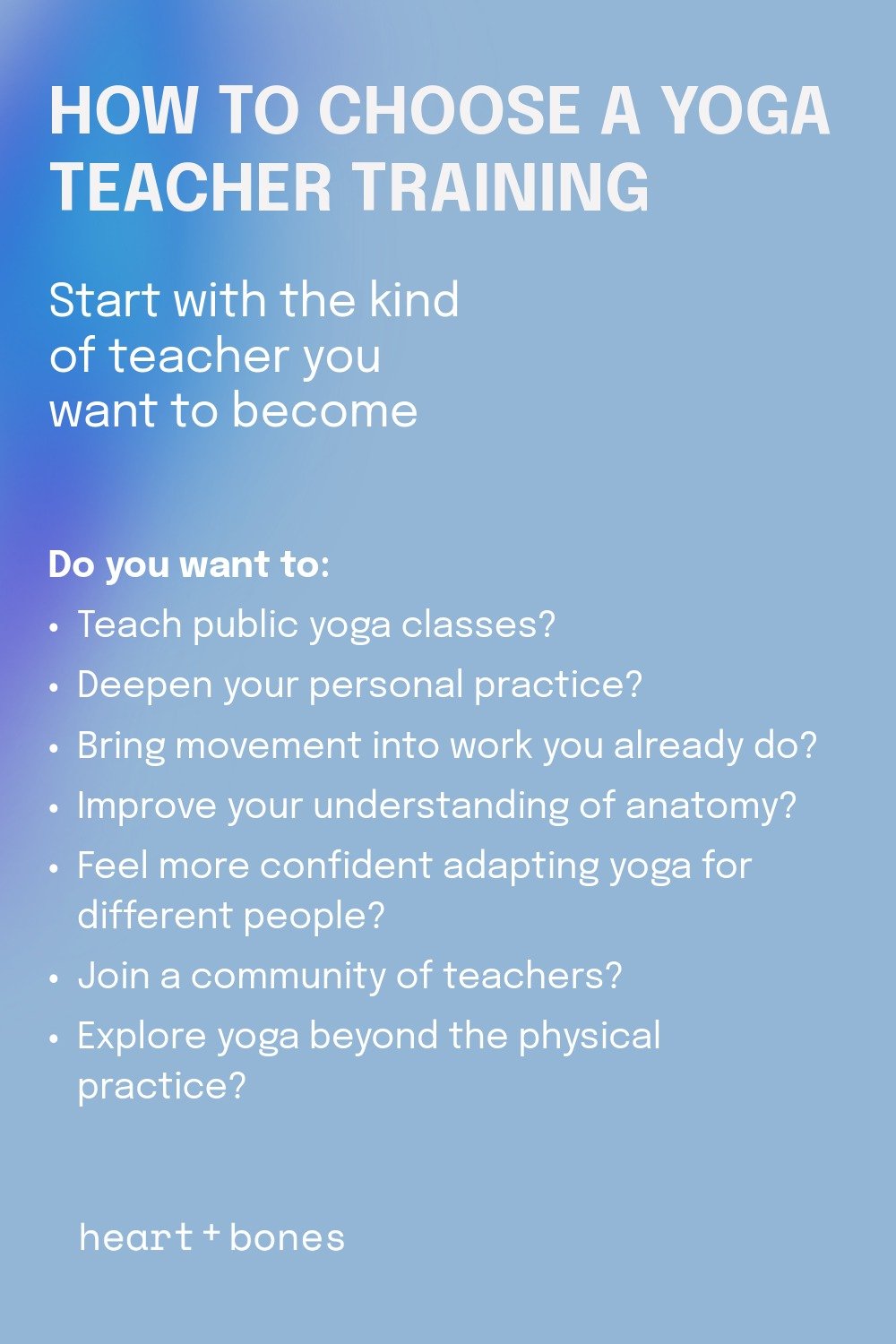
Start with the kind of teacher you want to become
Before comparing tuition, schedules, or yoga styles, ask yourself why you want to take a yoga teacher training.
Do you want to:
- Teach public yoga classes?
- Deepen your personal practice?
- Bring movement into work you already do?
- Improve your understanding of anatomy?
- Feel more confident adapting yoga for different people?
- Join a community of teachers?
- Explore yoga beyond the physical practice?
You do not need to have your entire teaching career planned before you begin. Your answer may also change during the training.
But your goals should influence what you look for.
Someone who wants to teach public classes needs practice teaching, feedback, sequencing skills, and experience responding to students. Someone primarily interested in deepening their practice may care more about philosophy, history, or exploring a particular tradition.
Many people want both.
The important thing is to look past the general promise to “transform your practice” and find out what you will actually learn to do.
Choose a foundation before choosing a specialization
One of the biggest questions prospective yoga teachers ask is:
What style of yoga should I train in?
There is no single correct answer. However, your first yoga teacher training does not need to lock you into one highly specific style.
Specialized training can be useful. You may eventually study restorative yoga, yin, prenatal yoga, chair yoga, yoga for older adults, or another distinct area. Those programs are most valuable when they build on a strong foundation.
For your first training, look for an education that helps you understand:
- How bodies move
- How to create an intentional class
- How and why poses can be adapted
- How to observe what is happening in the room
- How to communicate without overwhelming students
- How to make decisions when a memorized sequence no longer works
A foundational training gives you tools that can travel with you. You can then apply those tools across different classes, populations, and teaching environments.
A narrow method may teach you exactly how to deliver one class. A strong foundation teaches you how to build the class that is needed.
How important is lineage when choosing a YTT?
The word lineage can refer to the teachers, traditions, and systems through which yoga knowledge has been passed down.
Understanding where your teachers learned and how a program relates to yoga’s history can be valuable. A training should not present yoga as a collection of exercises disconnected from its cultural and philosophical roots.
But lineage should not be treated as a guarantee of quality.
Claims about an “unbroken lineage” can sound impressive without telling you whether the program includes:
- Useful anatomy education
- Practice teaching
- Individual feedback
- Inclusive teaching strategies
- Adaptable sequencing skills
- Preparation for working with different bodies
A training can respect yoga’s history without requiring unquestioning loyalty to one teacher, method, or organization.
Ask how the program engages with yoga’s roots. Also ask how it prepares you to teach the humans who will actually be in front of you.
You need both context and practical teaching skills.
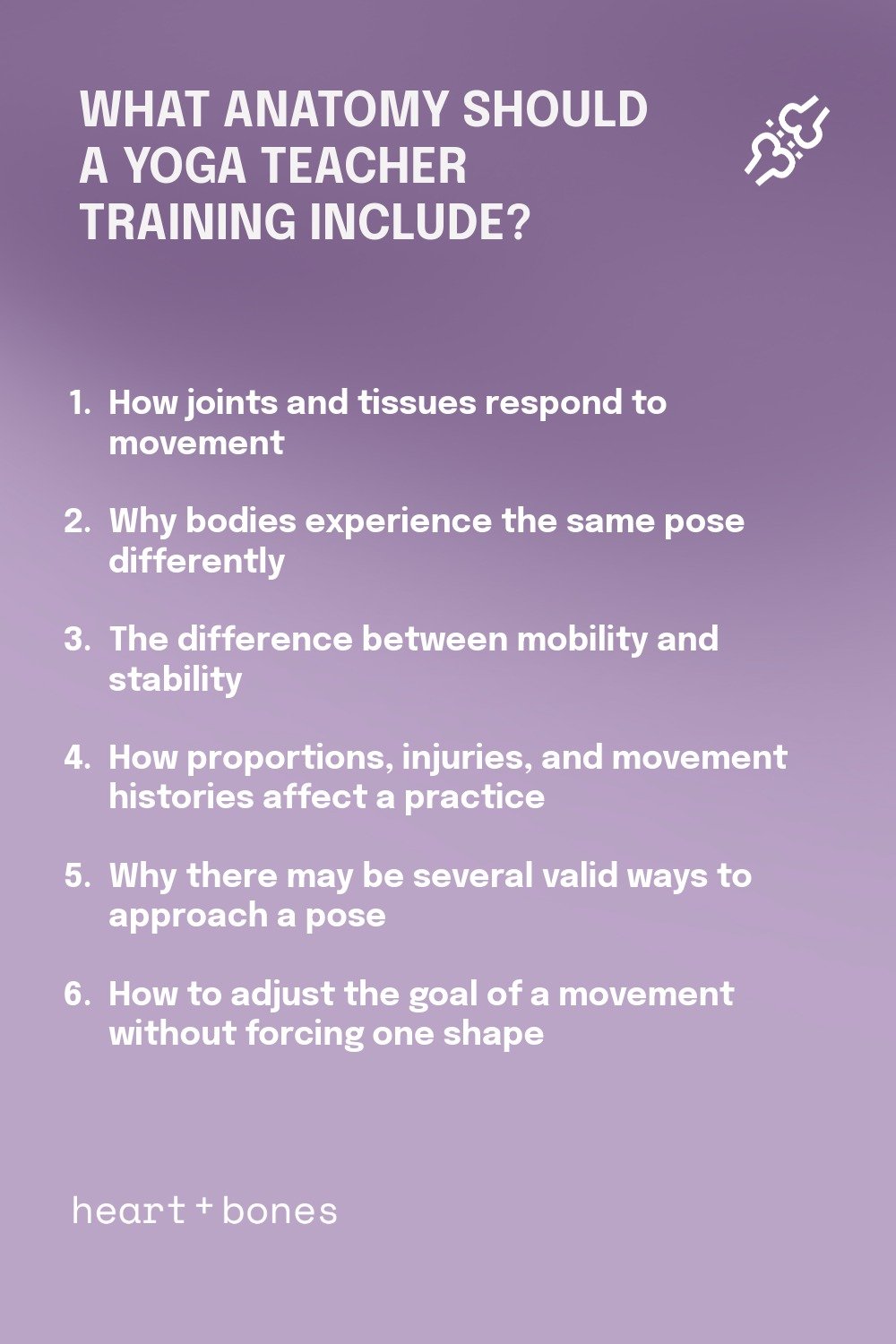
What anatomy should a yoga teacher training include?
Anatomy should help you make better teaching decisions. It should not be a long list of muscles and bones you memorize for a test and promptly forget.
Useful anatomy education helps you understand:
- How joints and tissues respond to movement
- Why bodies experience the same pose differently
- The difference between mobility and stability
- How proportions, injuries, and movement histories affect a practice
- Why there may be several valid ways to approach a pose
- How to adjust the goal of a movement without forcing one shape
Ask how anatomy is taught and how it connects to practice, sequencing, and cueing.
If the program teaches anatomy separately from everything else, find out how students learn to apply that information. Knowing the name of a muscle is not the same as knowing what to do when a student cannot comfortably follow your instructions.
Look for practice teaching and useful feedback
You cannot learn to teach yoga only by watching lectures.
Teaching requires practice.
A yoga teacher training should give you opportunities to:
- Teach other students
- Create and test sequences
- Practise cueing aloud
- Receive specific feedback
- Reflect on what worked
- Try again
Find out how much practice teaching is included and what that practice looks like.
Will you teach a complete class or only a few poses? Is feedback provided by experienced faculty? Will you have more than one opportunity to apply it? Does the group discuss why a teaching choice worked, or are students simply told to follow a set formula?
Good feedback should help you understand the effect of your decisions. It should not pressure every graduate to sound exactly like the lead teacher.
The goal is to help you become more skilful, not more imitative.
Make sure you will learn how to sequence a yoga class
Many yoga teacher trainings give students sample sequences without fully teaching them how to create their own.
A template can be helpful when you are beginning. But eventually, you need to understand why one movement follows another.
Look for a training that teaches you how to consider:
- The purpose or theme of the class
- Who the class is for
- What movements prepare students for what comes next
- How effort and ease are distributed
- How pace affects the student experience
- What can be changed when the original plan is not working
- How to build variety without constantly inventing new poses
Sequencing is not about making a class as creative or complicated as possible. It is about making intentional choices for the people practising with you.
Look closely at how cueing is taught
New teachers are often given scripts or alignment rules to memorize.
That may provide a place to begin, but cueing real students requires more than reciting instructions.
A strong training should help you learn how to:
- Give clear action-based cues
- Explain the purpose of a movement
- Avoid overloading students with information
- Offer choices without turning every pose into a lecture
- Use language that supports agency
- Observe how students respond
- Change your cue when the first one does not land
You do not need a perfect script. You need to understand what you are asking students to do and why you are asking them to do it.
How to choose the best online yoga teacher training
Online yoga teacher training can offer flexibility, accessibility, and the ability to learn from teachers outside your local area.
But “online” describes the delivery format, not the quality of the education.
The best online yoga teacher training for you should still provide opportunities for active learning, interaction, teaching practice, and support.
Before registering, ask:
- Is the program entirely self-paced, or are there live components?
- Can students ask instructors questions?
- Is practice teaching included?
- Will you receive individual feedback?
- How long do you have access to the material?
- Are there deadlines or required live sessions?
- How are students connected with one another?
- What happens if you fall behind?
- Are the instructors actively involved in the training?
- Does the schedule work with your time zone and responsibilities?
Recorded material can be useful, especially when you want to revisit anatomy or teaching concepts. But watching videos is not the same as being mentored through the process of becoming a teacher.
The strongest online programs use the format intentionally. They combine flexible learning with real opportunities to participate, practise, ask questions, and receive feedback.
What matters less than you might think
Some details can influence your choice without being reliable signs of a good yoga teacher training.
A famous lead teacher
A large audience does not tell you how accessible the teacher will be during your training.
Find out who actually teaches the program, answers questions, observes your teaching, and provides feedback.
The largest pose library
You do not need hundreds of poses to teach a thoughtful class.
You need to understand the movements you use, their purpose, and how to adapt them.
The fastest certification
A compressed program is not automatically poor quality, and a longer program is not automatically better. But learning requires time to practise, reflect, receive feedback, and integrate new information.
Ask whether the schedule gives you enough time to do that.
A promise that you will develop the “perfect” teaching voice
Your teaching voice develops through experience.
A training can help you communicate clearly and confidently. It should not turn every student into a copy of one teacher.
Training in the “right” yoga style
Styles can be helpful containers, but they are not substitutes for teaching skills.
A versatile foundation can prepare you to study specialized approaches later without limiting how you teach now.
A possible teaching job
Be cautious when a studio hints that completing its training could lead to employment.
Ask direct questions:
- How many graduates have been hired?
- Is an audition required?
- Are there guaranteed opportunities or simply the possibility of applying?
- What other qualifications does the studio consider?
Do not choose a program based on a vague implication that a job may follow.
Red flags when comparing yoga teacher training programs
Pause and ask more questions if a program:
- Guarantees that you will be ready for every teaching situation
- Promises employment without explaining the hiring process
- Avoids sharing a detailed curriculum
- Does not identify who will teach each part of the program
- Offers little or no practice teaching
- Provides no meaningful feedback
- Treats one body shape as the correct expression of every pose
- Discourages questions about its teaching methods
- Centres loyalty to one teacher more than student learning
- Requires ongoing payments to retain a branded teaching title
- Is unclear about additional fees, attendance, or certification requirements
- Claims its lineage or registration status proves that it is the best choice
You are investing significant time, money, and energy. It is reasonable to ask specific questions before you enrol.
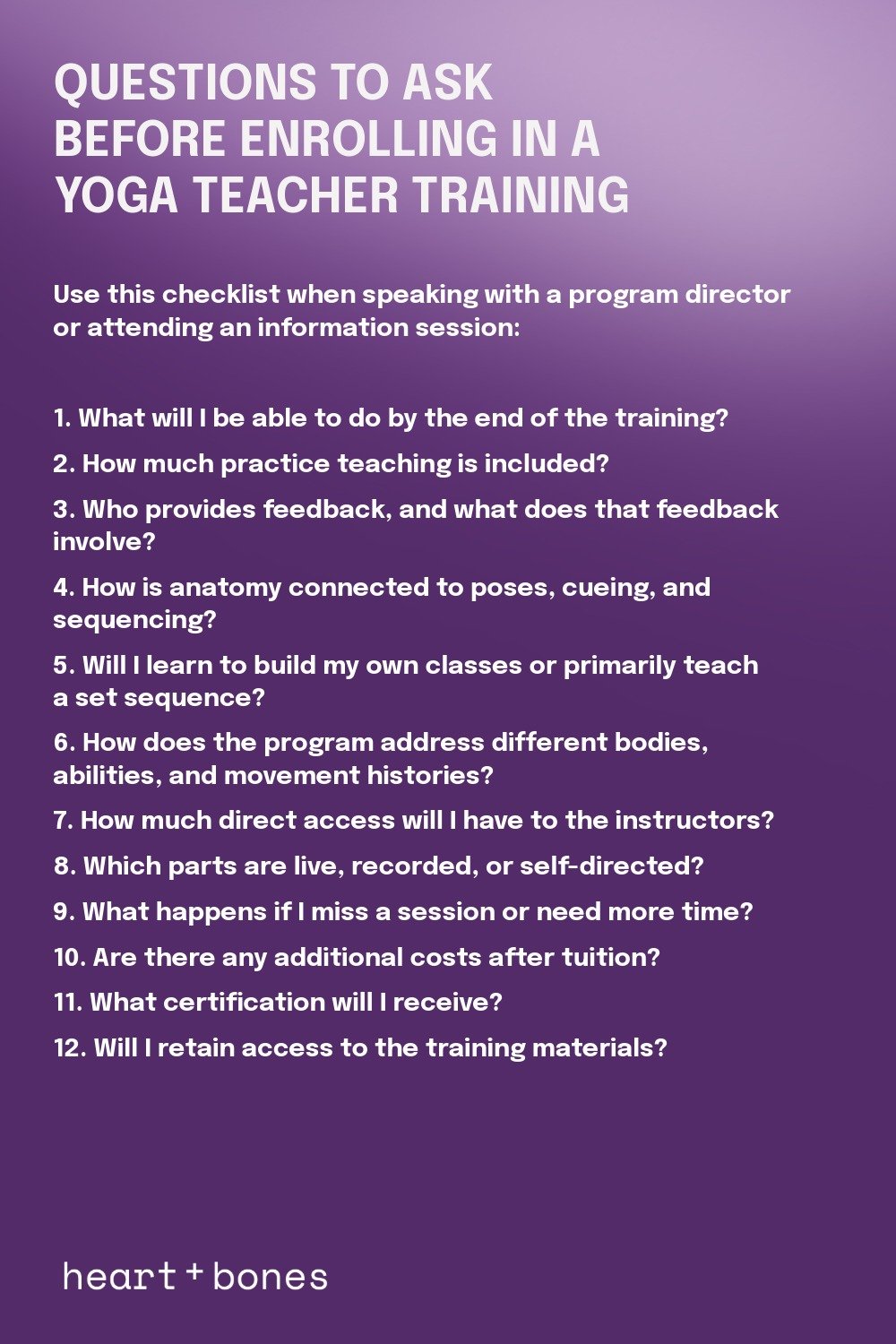
Questions to ask before enrolling in a yoga teacher training
Use this checklist when speaking with a program director or attending an information session:
- What will I be able to do by the end of the training?
- How much practice teaching is included?
- Who provides feedback, and what does that feedback involve?
- How is anatomy connected to poses, cueing, and sequencing?
- Will I learn to build my own classes or primarily teach a set sequence?
- How does the program address different bodies, abilities, and movement histories?
- How much direct access will I have to the instructors?
- Which parts are live, recorded, or self-directed?
- What happens if I miss a session or need more time?
- Are there any additional costs after tuition?
- What certification will I receive?
- Will I retain access to the training materials?
A different approach to online yoga teacher training
At Heart + Bones Yoga, our online Yoga Teacher Certification is built around teaching people, not performing poses.
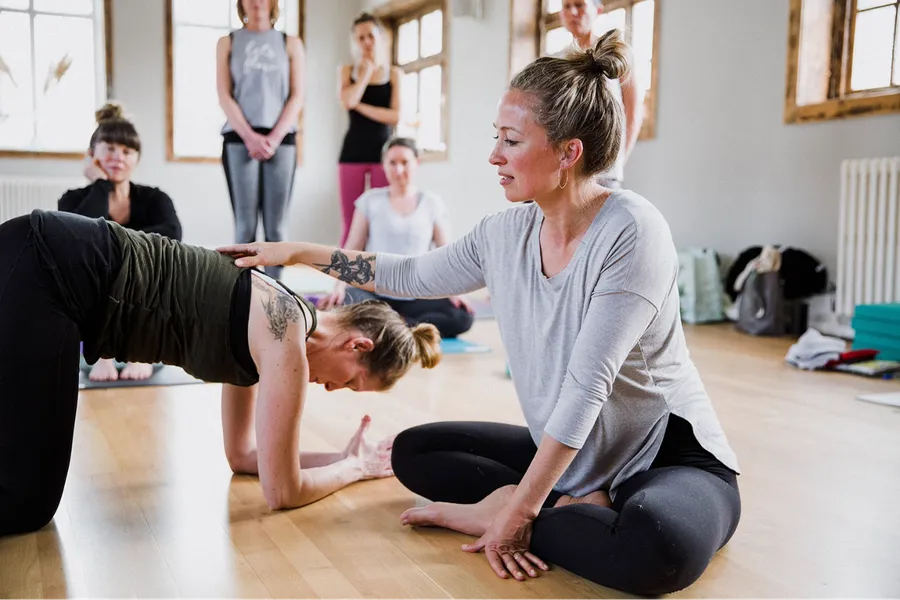
Explore the Heart + Bones Yoga Teacher Certification
You will learn applied anatomy, sustainable sequencing, adaptable cueing, and practical teaching skills that help you work with a wide range of bodies. The program combines flexible online learning with live mentorship, practice teaching, feedback, and a community of teachers learning alongside you.
Modern Yoga Essentials
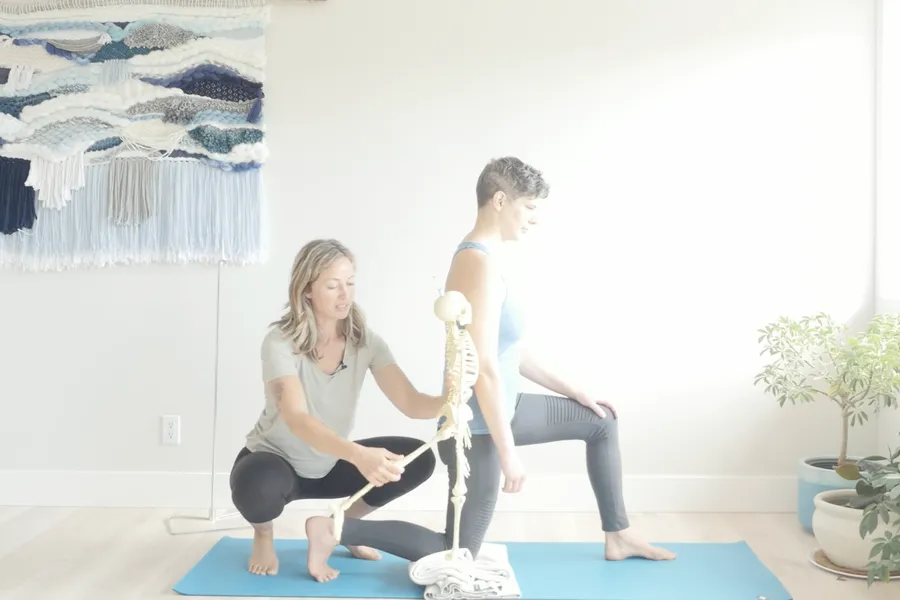
Modern Yoga Essentials is a 10-hour applied anatomy course that helps yoga teachers move beyond memorizing muscles and start understanding movement. Teach with more confidence, adapt poses for real bodies, and finally understand the why behind your cues.
Frequently asked questions about choosing a yoga teacher training
How do I choose a good yoga teacher training?
Choose a program that includes applied anatomy, sequencing, cueing, practice teaching, meaningful feedback, and tools for adapting yoga to different people. Review the curriculum, instructors, format, costs, certification, and graduate support before enrolling.
What should I look for in an online yoga teacher training?
Look for a balance of flexibility and interaction. A good online YTT should include opportunities to ask questions, practise teaching, receive feedback, connect with instructors, and apply what you learn. Do not judge an online program only by the number of recorded hours it contains.
Does yoga teacher training need to be Yoga Alliance certified?
No. Yoga Alliance registration is voluntary and is not a legal requirement for teaching yoga. Graduating from a Registered Yoga School matters if you want to apply for the RYT designation or if a particular employer requests it. Registration alone does not guarantee the quality or suitability of a training.
Is a 200-hour yoga teacher training enough to teach?
A 200-hour program can provide a foundation for beginning to teach, but the quality and content of programs vary. Look closely at how much teaching practice, feedback, anatomy, sequencing, and mentorship the training includes. Continued education and experience remain important after graduation.
Should my first yoga teacher training focus on one style?
Not necessarily. A style-specific program may suit you if you already know that you want to teach within that method. Otherwise, a foundational training that teaches adaptable anatomy, sequencing, cueing, and teaching skills can give you more flexibility. You can add specialized training later.
Can I take yoga teacher training if I do not want to teach?
Yes. Many people complete yoga teacher training to deepen their practice, better understand movement, study yoga philosophy, or become part of a learning community. Be honest about your goals so you can choose a program that gives enough attention to the areas you value.