May 19, 2026
Yoga for Gardeners: A Complete Guide to Stretches, Strength, and Back Care
Gardening can feel peaceful, grounding, and deeply satisfying. You get your hands in the soil, tend to something living, and spend time outside. It can feel like the opposite of a workout.
But your body may not always love the positions you find yourself in while lifting soil, pulling weeds, or getting your seeds into the ground.
Gardening asks a lot from you: bending, lifting, squatting, kneeling, carrying, pulling, reaching, gripping, twisting, and getting up and down from the ground over and over again. No wonder your lower back, hips, knees, wrists, shoulders, or neck might feel cranky after a long afternoon in the garden.
And if you love gardening, the answer is not to stop gardening. And it’s not necessarily to stretch aggressively afterwards and hope for the best.
A better question is:
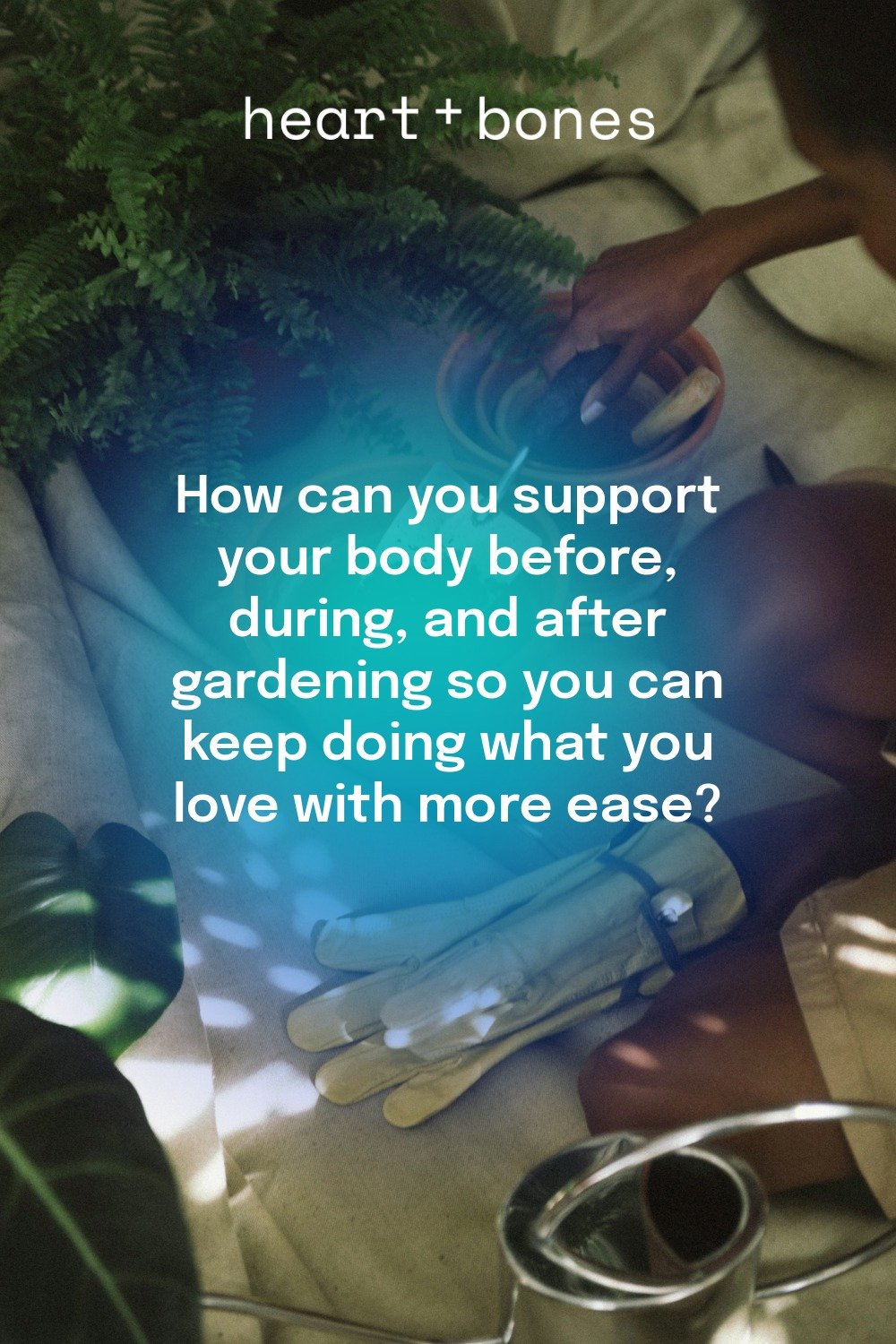
How can you support your body before, during, and after gardening so you can keep doing what you love with more ease?
That’s where yoga for gardeners can be so helpful. Not because you need a complicated routine or perfect poses, but because a thoughtful yoga practice can help you build strength, mobility, body awareness, and more options for how you move.
In this post:
- Why gardening can make your body sore
- Stretches for gardeners before and after gardening
- Gardening stretches for your back, hips, knees, wrists, and shoulders
- How to prevent back pain while gardening
- How to protect your knees while gardening
- How to support your wrists and hands
- Why gardeners need strength, not just stretching
- How the Heart + Bones Gardening Playlist can help
Yoga for Gardeners: Why Gardening Can Make Your Body Sore
Gardening is full of dynamic movement. That’s one of the reasons it can feel so good.
You’re not just sitting still. You’re moving between the ground and standing. You’re shifting soil, pulling weeds, carrying pots, planting seeds, pruning, watering, digging, and reaching into awkward little corners of your garden bed.
The challenge is that a lot of gardening movements are repetitive.
You might bend from the same part of your back again and again. You might kneel on the same knee for a long time. You might always reach with your dominant hand. You might grip tools for longer than your hands and wrists are used to. You might squat or crouch until your hips and knees start to complain.
The issue usually isn’t one “bad” movement.
It’s doing the same movement, in the same position, for longer than your body enjoys.
That’s why back pain after gardening, tight hips, sore knees, wrist discomfort, and achy shoulders are so common. Your body isn’t broken. It has simply been asked to do a lot of work in a limited range of positions.
Stretches for Gardeners: What Your Body Needs Before and After Gardening
When people search for stretches for gardeners, they’re usually looking for relief. Maybe the lower back feels tight. Maybe the hips feel stiff. Maybe the shoulders and wrists feel overworked after pulling weeds or pruning.
Stretching can absolutely help, but it’s useful to think about timing.
Before gardening, your body usually benefits from gentle movement that helps you warm up.
After gardening, your body may prefer slower stretches, supportive positions, and a chance to settle.
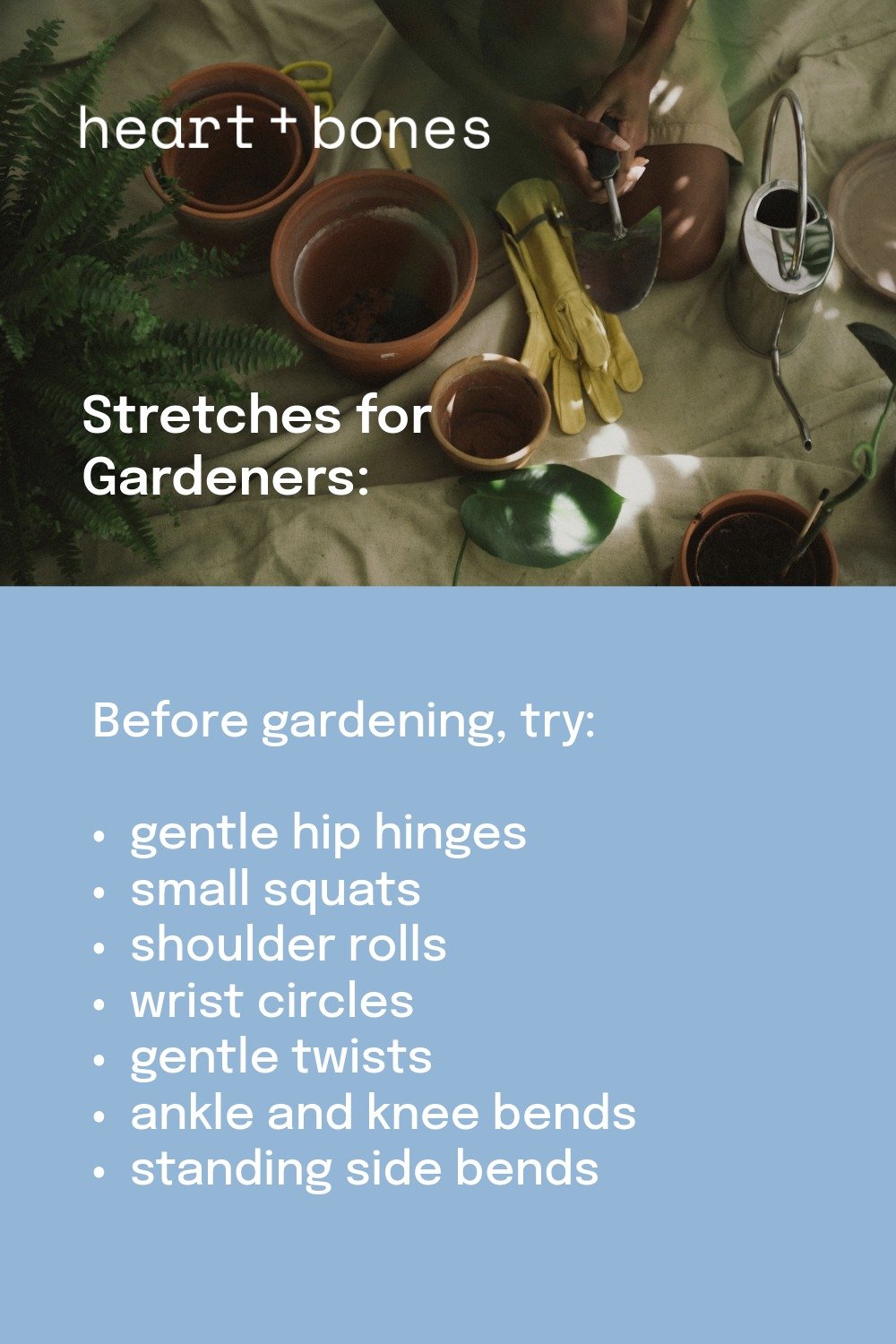
Before gardening, try simple movements like:
- gentle hip hinges
- small squats
- shoulder rolls
- wrist circles
- gentle twists
- ankle and knee bends
- standing side bends
The aim of these movements is to remind your joints and muscles that they’re about to move in many different ways. Gardening is a whole-body activity, and much like a runner, you’re warming up—not exhausting yourself before you even get outside.
After gardening, try slower stretches and recovery movements like:
- a supported child’s pose
- cat-cow
- a low lunge or hip flexor stretch
- a gentle seated or reclined twist
- legs resting on a chair
- wrist and finger stretches
- a few minutes of slow breathing
With these slower movements, you help your body transition out of work. The goal isn’t to force your body into deep stretches, rather think slow, mindful, and supportive.
Try the Heart + Bones Gardening Playlist
If gardening is part of your life, your movement practice can support it. Inside the Heart + Bones online studio, the Gardening Playlist brings together classes chosen to help your body feel better before, during, and after time in the garden. These classes support the areas gardeners often feel most: the lower back, hips, knees, wrists, shoulders, core, and whole body.
How to Prevent Back Pain While Gardening
Back pain after gardening is one of the most common complaints, and it makes sense.
So much of gardening happens close to the ground. Weeding, planting, digging, lifting soil, moving pots, and picking things up all ask your body to bend forward.
Your spine is allowed to round. Rounding your spine is not bad. But if every bend comes from your lower back, especially while lifting, pulling, or carrying, your back may start to feel overworked.
One helpful movement to practise is the hip hinge.
A hip hinge means bending from your hips instead of relying only on your lower back. It helps your legs, hips, glutes, and core share the work.
This matters in the garden because you use this movement constantly: bending toward the soil, picking something up, moving a pot, lifting a bag of soil, or reaching into a garden bed.
Instead of thinking, “How low can I fold?” try thinking:
Can I shift my hips back and let my legs help me?
This is where Brea’s classic gardening cue still works beautifully:
More Butt, More Better.
When you send your hips back, bend your knees, and let your glutes and legs help support the movement, your lower back does not have to do everything by itself.
In the video below, Brea walks you through creative ways to understand the hip hinge in your own body. This is a helpful practice for gardeners because it connects directly to bending, lifting, carrying, and getting up and down with more support.
You don’t need to master it immediately. Like any movement pattern, it can take time for your body and brain to understand what you’re asking them to do.
Start small. Practise often. Let it become familiar.
How to Protect Your Knees While Gardening
Gardening can be hard on the knees, especially if you spend a lot of time kneeling, squatting, or moving from the ground to standing.
The first step is support.
Use a folded towel, yoga mat, gardening pad, or cushion under your knees. This is not cheating. It’s smart. Your body does not need to be uncomfortable for gardening to “count.”
Then, change positions often.
Instead of kneeling in the same way for an hour, try moving between:
- both knees down
- one knee down and one foot forward
- sitting on a low stool
- squatting for short periods
- standing and bending from the hips
- sitting on the ground if that feels good for your body
You can also switch which knee is down, which foot is forward, and which side you reach from.
If squatting feels difficult, try placing something under your heels for support. This can make the position feel more accessible for some bodies. You can also keep the squat higher and less deep.
The goal is not to force your knees into a position they don’t like.
The goal is to find more ways to work close to the ground without asking one joint to handle the whole job.
Wrist Pain From Gardening: How to Support Your Hands and Wrists
Your hands and wrists do a lot in the garden.
Pulling weeds, gripping tools, pruning, carrying watering cans, digging, planting, and pressing into the ground can all add up.
If you already spend time typing, texting, cooking, crafting, or working with your hands, gardening can layer even more demand onto tissues that may already be working hard.
To support your wrists and hands while gardening, try:
- switching hands when possible
- changing your grip on tools
- taking short breaks to open and close your hands
- avoiding one fixed wrist angle for too long
- shaking out your hands between tasks
- using tools with comfortable handles
- letting larger muscles help instead of gripping harder
Try these classes to support those tender hands and wrists:
How to Support Your Shoulders While Gardening
Shoulders often get overlooked in gardening, but they’re doing plenty.
Reaching, carrying, lifting, pruning, pulling, watering, and working with tools all ask your shoulders, upper back, arms, and ribcage to coordinate.
If your shoulders feel sore after gardening, it may not be because they are “weak” or “tight.” They may simply be tired from doing a lot of repetitive work.
Support your shoulders by changing how you reach and carry.
Try switching arms when possible. Keep heavier loads closer to your body. Avoid always reaching from the same side. Pause to roll your shoulders, move your ribcage, and take a few deeper breaths.
Gentle shoulder mobility before gardening can also help.
Try:
- shoulder rolls
- arm circles
- reaching arms forward and overhead
- gentle upper back twists
- squeezing and widening the shoulder blades
- side bends with relaxed arms
You don’t need a full shoulder workout before gardening. Just give your upper body a chance to wake up before it starts pulling, carrying, and reaching.
Try this class and get those shoulders rolling:
How Yoga Helps Gardeners Build Mobility, Strength, and Body Awareness
Yoga can support gardeners because it helps you pay attention to how you move.
You start to notice when you always bend the same way. You notice when one side does more work. You notice when your breath gets held while lifting. You notice when you’ve been gripping too hard, kneeling too long, or asking your lower back to do the work your legs could be helping with.
That awareness matters.
Yoga also gives you more movement options.
Instead of thinking there is one perfect way to bend, kneel, squat, stretch, or lift, you start to build a bigger movement vocabulary.
You can move your spine in different directions. You can support your hips with strength and mobility. You can work with balance and coordination. You can practise getting down to the ground and back up again. You can learn how your core, shoulders, legs, and breath work together.
And because gardening is often calming and mindful in its own way, yoga can support the nervous system side of the practice too.
Gardening already invites presence. Yoga can help your body feel supported enough to enjoy it.
Try the Heart + Bones Gardening Playlist
If gardening is part of your life, your movement practice can support it. Inside the Heart + Bones online studio, the Gardening Playlist brings together classes chosen to help your body feel better before, during, and after time in the garden. These classes support the areas gardeners often feel most: the lower back, hips, knees, wrists, shoulders, core, and whole body.
Members can also explore:
- the Gardening Playlist
- the Healthy Core Month Challenge
- posture-focused classes
- core classes in the search bar
- Amanda’s strength classes
- classes for hips, shoulders, spine, and lower back support
You can use these classes before gardening as a warm-up, after gardening as recovery, or throughout the week to build more strength, mobility, and ease.
Because the best movement practice is not the one that asks you to become someone else.
It’s the one that helps you keep doing the things you love.
FAQ: Yoga for Gardeners, Gardening Stretches, and Back Pain After Gardening
Is yoga good for gardeners?
Yes, yoga can be a helpful support for gardeners because it can build mobility, strength, balance, body awareness, and relaxation. Gardening asks your body to bend, squat, kneel, lift, carry, grip, and reach. A thoughtful yoga practice can help prepare your body for those movements and support recovery afterwards.
What are the best stretches for gardeners?
The best stretches for gardeners usually support the back, hips, knees, wrists, hands, shoulders, and legs. Gentle hip flexor stretches, spinal movements, wrist mobility, shoulder mobility, hamstring stretches, and restorative positions can all be useful after gardening.
How do I prevent back pain while gardening?
To help prevent back pain while gardening, change positions often, bend your knees, shift your hips back when reaching toward the ground, and avoid asking your lower back to do all the work. Practising a hip hinge can help your legs, hips, glutes, and core support bending and lifting.
Why does my back hurt after gardening?
Your back may hurt after gardening because gardening often involves repeated bending, lifting, reaching, pulling, and carrying. If your lower back is doing most of that work for a long time, it may feel tired or sore afterwards. Supporting your hips, legs, core, and movement variety can help.
What helps sore knees after gardening?
For sore knees after gardening, try using padding under your knees, changing positions more often, switching which knee is down, using a stool or kneeler, and adding gentle strength and mobility work for your legs and hips. If knee pain is sharp, persistent, or worsening, check with a healthcare professional.
How do I prevent wrist pain from gardening?
To help prevent wrist pain from gardening, switch hands when possible, change your grip, take short hand breaks, use comfortable tools, and move your wrists and fingers before and after gardening. Gentle wrist circles, hand opening, and finger stretches can help reduce stiffness from repetitive gripping.
Should I stretch before or after gardening?
Both can be helpful. Before gardening, gentle movement can help warm up your body. After gardening, slower stretches and recovery positions can help your body settle. You don’t need a long routine. A few minutes of thoughtful movement can make a difference.
What yoga should I do after gardening?
After gardening, choose yoga that supports your lower back, hips, shoulders, wrists, and nervous system. Gentle mobility, slow stretching, supported rest, and breath-focused practices can all be helpful. Inside Heart + Bones, members can use the Gardening Playlist for classes chosen specifically to support the body after gardening.
Try the Heart + Bones Gardening Playlist
If gardening is part of your life, your movement practice can support it. Inside the Heart + Bones online studio, the Gardening Playlist brings together classes chosen to help your body feel better before, during, and after time in the garden. These classes support the areas gardeners often feel most: the lower back, hips, knees, wrists, shoulders, core, and whole body.